Books and Resources That Helped Me
Contents
Intro
I have found books and written guides more useful than many photography videos on YouTube. Videos can still help when I want to see how a piece of equipment works, but they do not always reflect the kind of photography I do.
Some videos focus heavily on new equipment, which can leave you thinking that you need the latest camera, lens or accessory to take better photographs. The photographer’s subject and working conditions may also be very different. I once watched someone demonstrate close-up photography by photographing spiders indoors. There was nothing wrong with that, but the techniques did not always translate well to photographing active bees outside.
Watching someone else go on an insect photography walk can be entertaining, but it cannot replace going into your own backyard or a nearby park and practising. Time spent outside has taught me more about light, focusing, bee behaviour and the equipment I already own.
Books and written guides let me slow down, study the fundamentals and return to a particular section when needed. Here are some of the photography and bee-related resources that have helped me along the way.
Photography Books
John Shaw’s Closeups in Nature — John Shaw
This is an older book from the film photography era, but many of its fundamental ideas are still relevant. It covers magnification, exposure, lenses, working distance and lighting.
I also enjoy the way John Shaw explains technical subjects. His writing is clear and practical without making close-up photography feel unnecessarily complicated. The book is available to read through the Internet Archive.
John Shaw’s Guide to Digital Nature Photography — John Shaw
This is a broader book about nature photography, but it includes a useful section on close-up photography.
It provides a good foundation for understanding exposure, composition, lighting and working with natural subjects. I would recommend reading something like this before becoming too distracted by equipment reviews and technique videos online.
The Manual of Close-Up Photography — Lester Lefkowitz
Published in 1979, this book can often be found second-hand at a reasonable price. My copy was previously owned by a library.
Like John Shaw’s earlier work, it was written during the film era, but much of the technical information remains useful. This is especially relevant to me because I use several vintage manual-focus lenses and accessories.
Lester Lefkowitz has also written more recent books on close-up photography. I have not read those yet, but they may be worth exploring if you prefer a newer reference.
Photography Websites and Forums
Photomacrography.net
Photomacrography.net is a long-running forum for people interested in close-up, macro and high-magnification photography.
Its discussions contain a great deal of practical knowledge about lenses, lighting, magnification, focus stacking and homemade equipment. Some threads are quite technical, but the forum is useful when I want to research a specific question.
Extreme Macro
Extreme Macro is a useful website for understanding the concepts behind high-magnification photography.
It explains reproduction ratios, reversed lenses, extension tubes, effective aperture, diffraction and focus stacking. Even if you do not plan to photograph at extreme magnifications, the site can help explain what happens as you move beyond 1:1.
Learning About Bees
Learning how to use the camera is only part of bee photography. Understanding the bees themselves has been just as important.
Knowing something about their size, preferred plants, nesting habits and behaviour makes them easier to find and photograph. It also helps me recognise interesting moments such as buzz pollination, roosting, nest building and nectar concentrating.
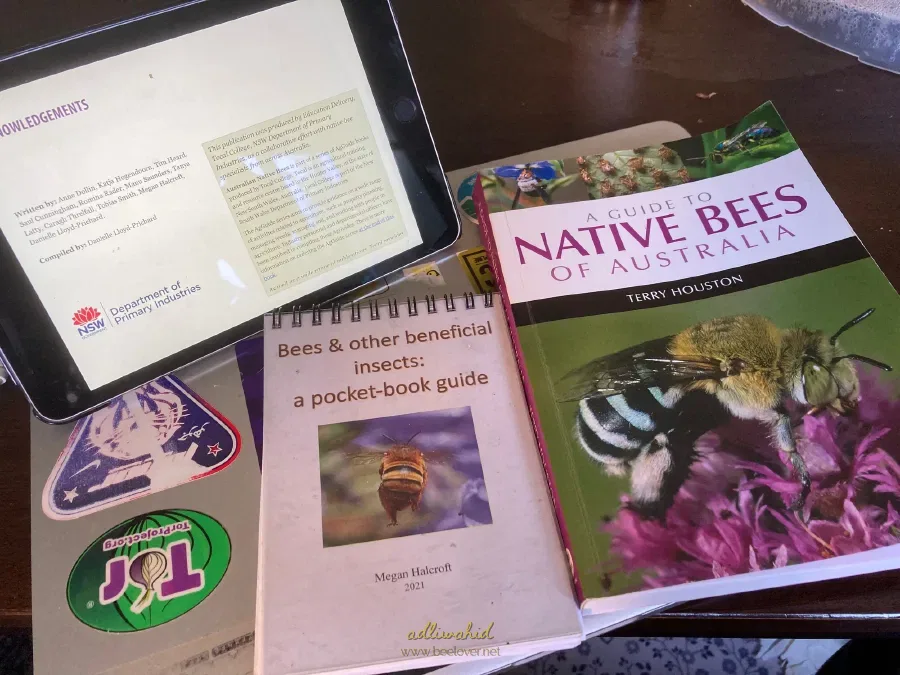
Bees and Other Beneficial Insects: A Pocket-book Guide — Megan Halcroft
This small guide is convenient to carry and provides a helpful introduction to Australian native bees and other beneficial insects.
It is particularly useful for beginners who want a simple reference for recognising some of the bees and insects they may encounter in the garden.
Australian Native Bees AgGuide — NSW Department of Primary Industries
I bought the electronic version because it includes interactive material such as video and audio.
The guide offers an accessible introduction to Australian native bees, including their biology, nesting habits and identification. I found it suitable for a beginner like me who wanted to learn more without starting with a highly technical identification key.
The Australian Bee Genera: An Annotated, User-Friendly Key — Tobias Smith
This is a more detailed guide to identifying the different genera of Australian bees. It is available as a free PDF from the website.
It becomes particularly useful when you want to move beyond broad descriptions such as “small black bee” and begin understanding the physical features used to distinguish one group from another.
A Guide to Native Bees of Australia — Terry Houston
This is a comprehensive reference on Australian native bees. It covers their diversity, biology, behaviour, nesting habits and relationships with plants.
It is a useful book to return to when I encounter a new bee and want to learn more about what I have observed or photographed.
Bees of the World: A Guide to Every Family — Laurence Packer
Most of my bee books focus on Australian species, but this one provides a much wider view. It introduces the world’s bee families and shows the remarkable variety of bees found across different regions.
The book is beautifully illustrated and covers bee anatomy, behaviour, classification, habitats and nesting. It is not designed as a field guide for identifying individual Australian species, but it is a useful and enjoyable introduction to bee diversity around the world.
It also fits nicely with my hope of photographing and learning about bees in other countries when opportunities arise.
Online Bee Communities
Bee Aware of Your Native Bees
Bee Aware of Your Native Bees is an Australian Facebook group administered by Megan Halcroft.
Members share photographs and observations, and experienced contributors often help with identification. It is also a good place to enjoy photographs from other bee enthusiasts and learn which species are being observed in different parts of Australia.
The group’s resource section contains additional guides and reading material for anyone interested in Australian native bees.
Workshops
Native Bee Workshops with Tobias Smith
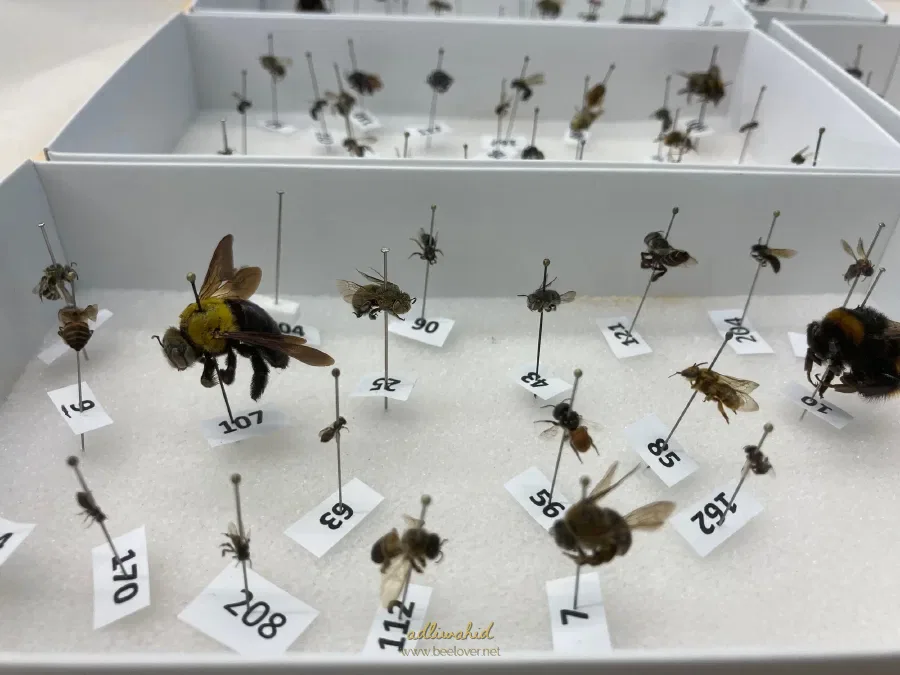
I attended a native bee identification workshop taught by Tobias Smith at The University of Queensland in 2021. It was an excellent introduction to the diversity of Australian native bees.
One of the highlights was examining different bees under a microscope. Seeing their sizes, body shapes and identifying features up close gave me a much better appreciation of how varied they are.
Tobias runs native bee education activities and workshops through Bee Aware Kids. If you are in Brisbane or elsewhere in South-East Queensland, it is worth checking the website or his social media pages for upcoming sessions.
Reading Helps, but Practice Matters
Books, websites and workshops can provide useful knowledge, but none of them replaces spending time outside with a camera.
You do not need to read every book on this list before getting started. One good close-up photography guide and a useful local bee reference may be all you need at first.
Reading can explain the fundamentals and help prevent unnecessary spending, but it needs to be combined with observation and practice. No book, website or video can replace time spent watching bees and learning how they behave.
In the end, the best resource may be the garden, park or patch of flowers near you. Take the camera you already have, go outside and see what you can find.